
About us
The Competence Network for Congenital Heart Defects
Networked Research to Promote Ideal Care
In Germany, between 6,000 and 7,000 children are born with congenital heart disease each year. A total of approximately 300,000 children, adolescents and adults currently live with this type of malformation across Germany. They depend on an ongoing specialized medical care. And on continuous research in this field.
The research infrastructure required for this purpose was established by setting-up the Competence Network for Congenital Heart Defects (KNAHF) in Germany. At the KNAHF, research is being conducted in the fields of congenital heart disease, as well as heart disease in childhood and adolescence.

As yet, too little is known about congenital heart disease and potential sequelae. Congenital heart disease is a primary disease that shows very heterogeneous disease patterns. As a result, single hospitals and research institutions are hardly able to collect sufficient data and samples for research. For this reason, the Competence Network for Congenital Heart Defects was set-up to create a network structure that enables reliable and independent research on the basis of a comprehensive data and sample collection. This is made possible by the National Register for Congenital Heart Defects, one of the biggest patient databases in this field across the globe.
Enabling Research
The Competence Network for Congenital Heart Defects was founded in 2003 within the framework of the initiative Competence Networks in Medicine, which was launched by the Federal Ministry of Education and Research (BMBF). The Competence Network’s core project is the National Register for Congenital Heart Defects. By setting-up the Register, the Competence Network created the prerequisites for international multicenter research in the field of congenital heart disease. More than 60,000 patients and relatives of patients contribute by donating their data and samples. Thanks to its comprehensive treasure of data and samples, the National Register provides scientists with a validated and representative research basis.
-
Campaign
Plaster Strip on the Heart
Raising Awareness for an Important Research Field
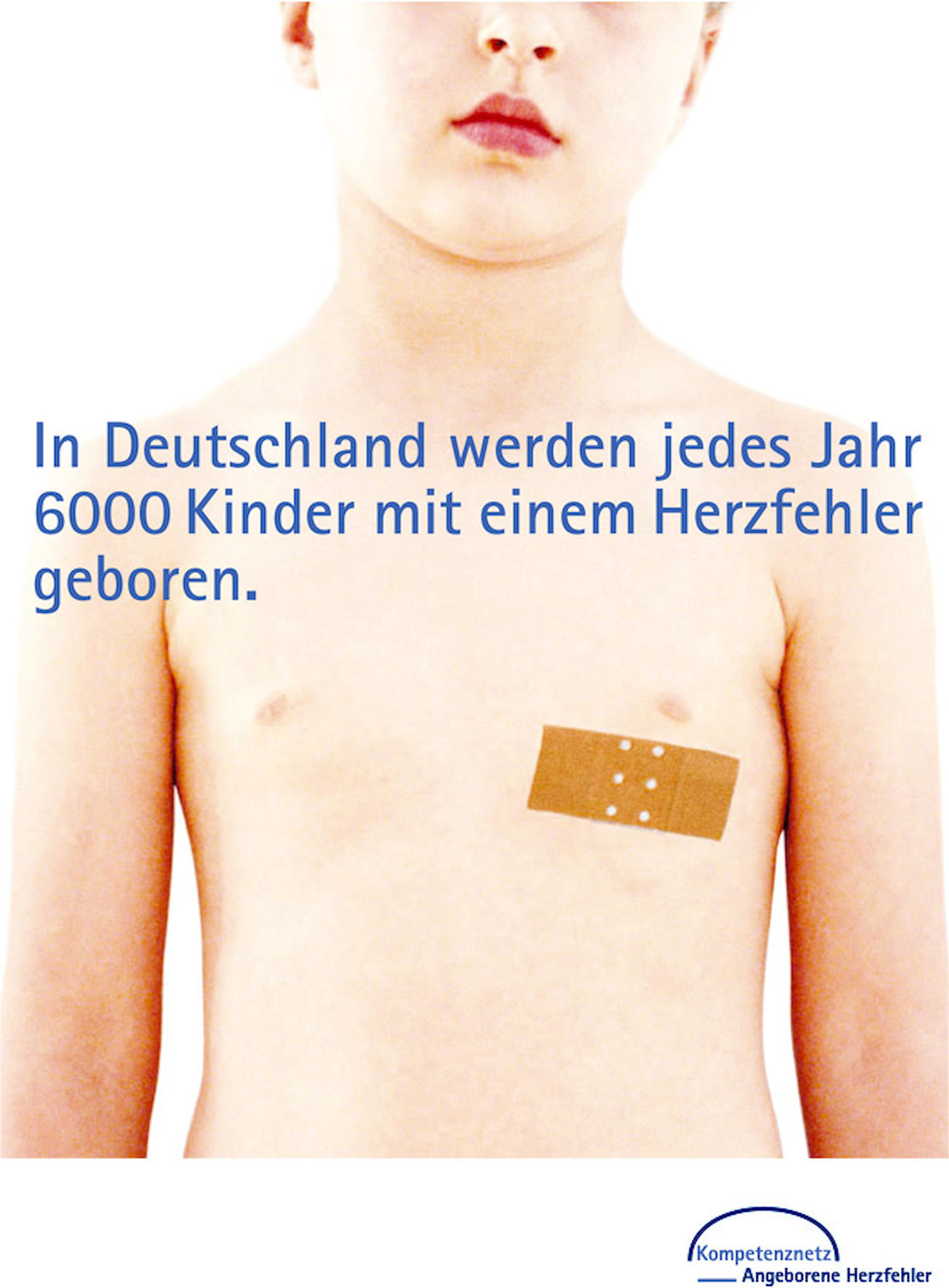
The Competence Network’s poster of 2008 shows a child with a plaster strip on its chest. With its poster campaign, the Competence Network for Congenital Heart Defects for the first time spotlighted the subject of congenital heart disease across Germany. By this, it also called attention to the need for joint research.
collapse
 ©
©As of August 2009, the Competence Network for Congenital Heart Defects was established as a registered scientific association. As such, it ensures independent and sustainable research. Over 30 universities, hospitals and research institutions, as well as pediatric cardiologists in private practice, cardiologists, rehabilitation physicians and scientists from all over the nation, including all pediatric heart centers in Germany, take part in the research network.
Ensuring the Transfer to Clinical Practice

The Competence Network has established a close exchange with patients’ associations and support groups. This is in line with the goal of generating research results that are aimed at the patients’ wellbeing and that find their way into clinical practice as swiftly as possible.
From medical basic research via clinical research through to healthcare research: Meanwhile, numerous research results generated by the Competence Network contribute to a better understanding of the causes and sequelae of congenital heart disease, as well as of appropriate measures of early detection, treatment and preventive care.
New diagnostic methods and forms of treatment have been developed. Furthermore, improvements in the medical care infrastructure for patients, as well as the cardiologic training for medical professionals were achieved.

Until 2014, the Competence Network for Congenital Heart Defects was mainly funded by the German Federal Ministry for Education and Research (BMBF). From 2015 to 2021, it was funded by the German Center for Cardiovascular Research, being its associated partner.
Since 2022, it has again been funded by the BMBF. The research network is supported by numerous institutions including, among others, the major cardiac societies, parents’ initiatives and patient associations, research institutions, foundations and representatives from industry. Friede Springer is the network’s patron.
Until today, clinical practice shows quite plainly the urgency of international joint research across locations. Many questions have yet to be answered to make a good life for all those affected possible, starting with the first heart beat through to old age.
 ©
©  ©
©  ©
©